
 (402) 431-2335

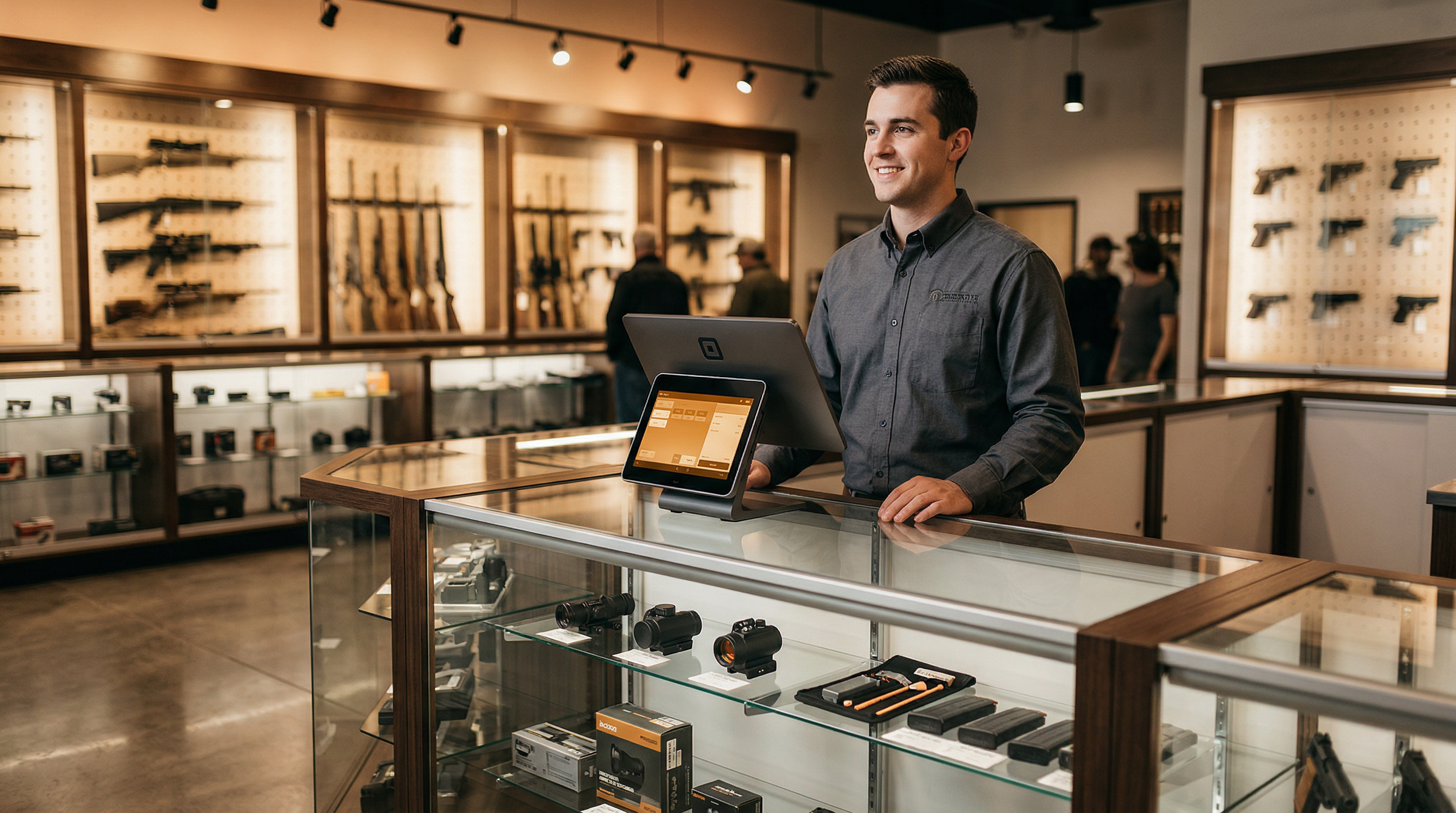
Most point of sale systems weren't built for gun stores. If you've ever tried cramming a generic retail platform into an FFL operation, you already know the pain.
Serialized inventory that doesn't track right. No bound book integration. Payment processing that freezes your account three weeks in because someone in risk management just realized you sell firearms. Finding the best point of sale systems for gun stores takes real research, and most "top 10" lists out there are written by people who've never set foot behind a gun counter.
At Gunpowdr, we work with gun stores, ranges, and firearms brands every single day. We've seen what happens when a dealer picks the wrong POS, and we've seen how the right one transforms an operation. This isn't a recycled list from some payment processor's blog. It's an honest breakdown based on what actually matters to firearms retailers.
We're going to walk you through the top systems worth considering, the features you can't skip, and a framework for choosing the one that fits your store. Let's get into it.
Why Gun Stores Can't Use Just Any POS System
Before we start naming names, let's talk about why this decision is so different for firearms retailers. If you sell shoes or coffee, almost any modern POS will work. Gun stores? Not even close.
ATF Compliance Is Non-Negotiable
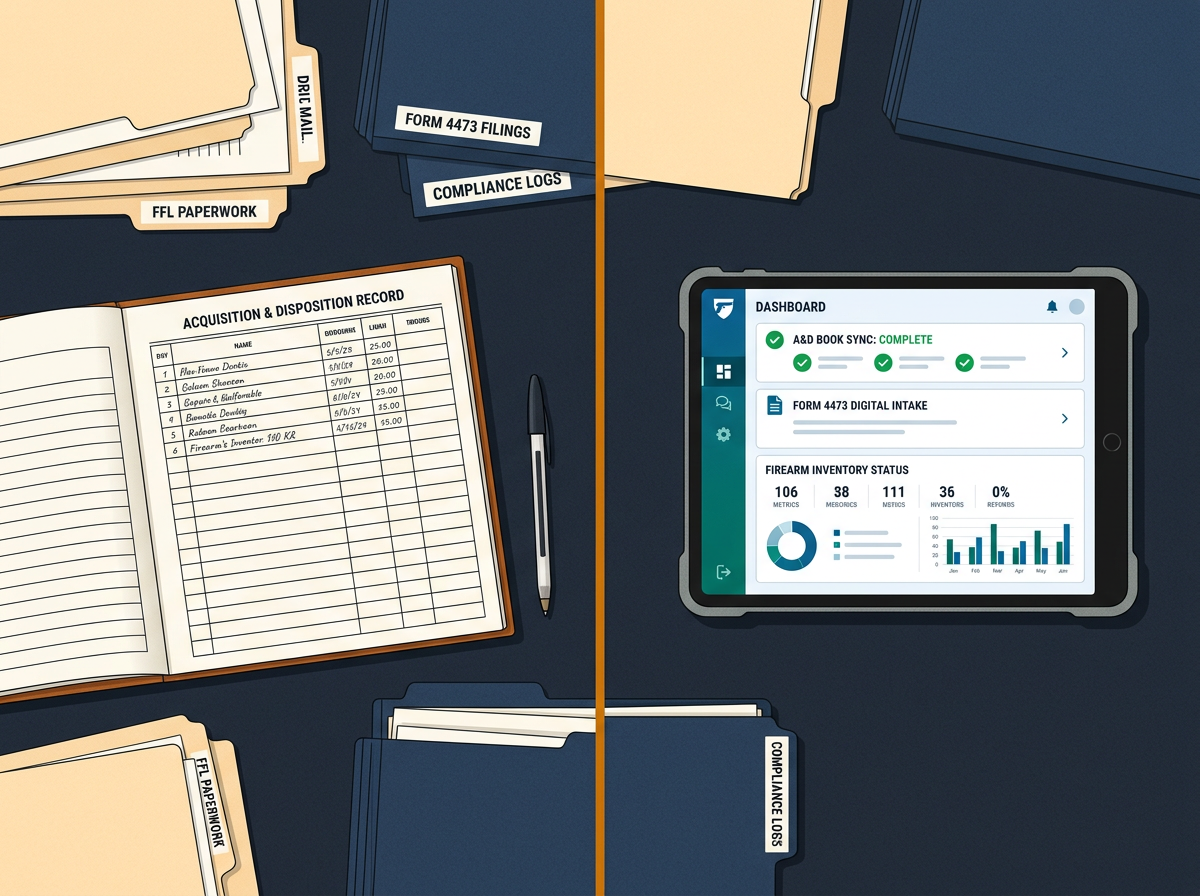
Your Acquisition & Disposition log (the bound book) has to be airtight. Not "pretty good." Not "mostly accurate." Airtight. Errors in your bound book can lead to ATF violations, and enough violations can mean losing your FFL.
Then there's 4473 form handling, whether paper or electronic. Your gun store point of sale needs to integrate with this process seamlessly, not treat it as an afterthought. A generic retail POS has zero awareness that any of this exists.
Serialized Inventory Changes Everything
Every firearm in your store has a unique serial number that must be tracked individually. This isn't the same as managing SKUs for t-shirts. Accessories, ammo, and firearms all behave differently in inventory, and your POS needs to handle all three without breaking a sweat.
Add consignment, trade-ins, and layaway into the mix, and most retail POS platforms fall apart completely.
Payment Processing Is a Minefield
Here's the thing most people don't realize until it's too late: firearms businesses are classified as "high-risk" by most payment processors. Mainstream POS platforms like Square, Shopify POS, and Toast will freeze or outright terminate your account when they figure out what you're selling.
You need a POS that either includes its own firearms-friendly payment processing or integrates cleanly with one that does. No exceptions.
So what should you look for? Here are the features that separate a real firearms POS from a generic system with a camo skin.
Must-Have Features in Point of Sale Software for Gun Stores
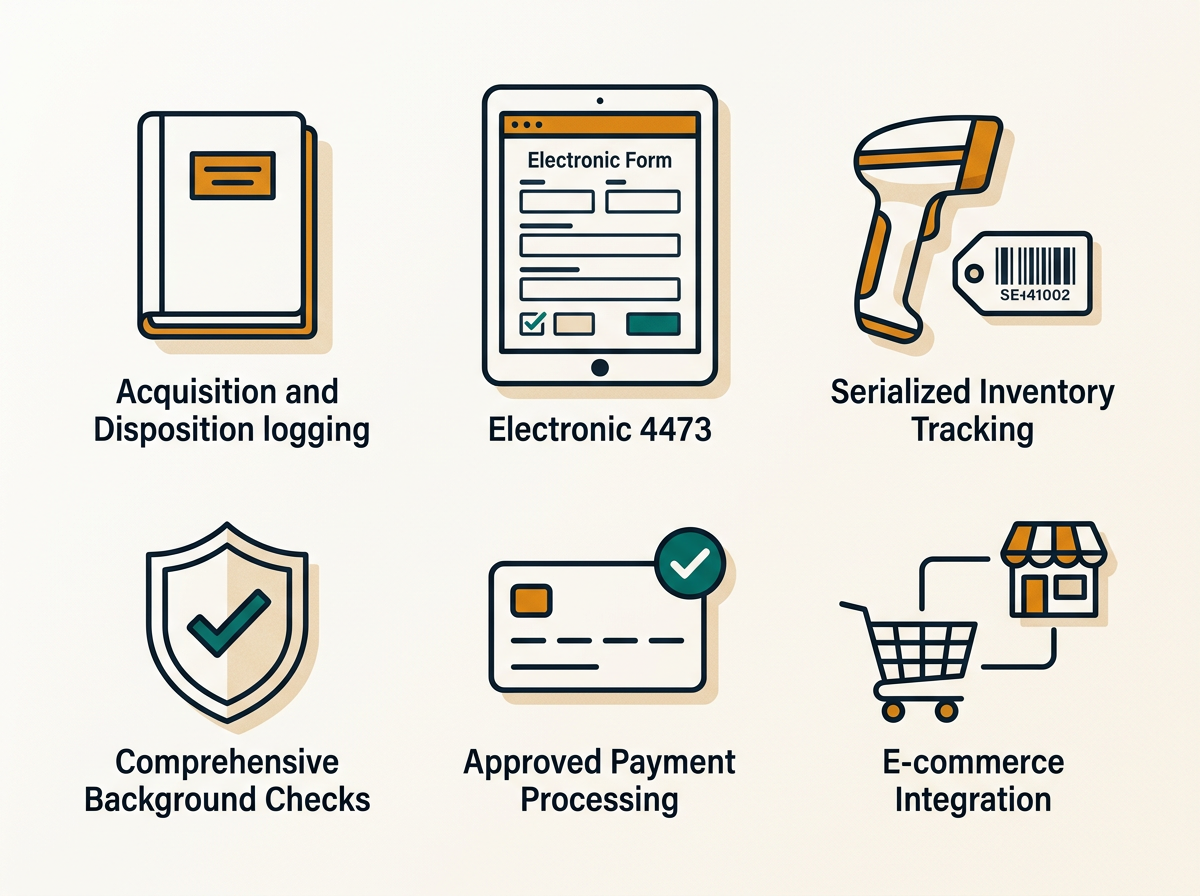
Think of this section as your evaluation checklist. Whether you go with one of the systems below or something else entirely, these are the features that any serious gun store point of sale system needs to deliver.
Bound Book / A&D Log Integration
This is the big one. Your POS should maintain a digital bound book that syncs with sales automatically. Every acquisition and disposition gets logged without you manually re-entering data into a separate system.
The best FFL POS software auto-populates entries from distributor imports, cutting down on the manual entry errors that trigger ATF headaches. If a system doesn't offer this natively, that's a red flag.
Electronic 4473 Support
E4473 integration (or at minimum, compatibility with platforms like SilencerShop or the ATF's eForm system) speeds up transactions and eliminates paper storage nightmares. Look for systems that make this part of the workflow, not a bolted-on extra step.
Serialized Inventory Management
You need to track every firearm individually by serial number through its full lifecycle: receiving, display, sale, transfer, or disposition. The system should also support consignment, layaway, trade-ins, and FFL transfers without clunky workarounds.
Bonus points if the system integrates with distributor catalogs like RSR Group, Lipsey's, or Sports South for quick receiving.
NICS / Background Check Integration
The ability to initiate or track NICS background checks from within the POS keeps your workflow tight. Status tracking (proceed, delayed, denied) should be tied directly to the transaction so nothing falls through the cracks.
High-Risk-Friendly Payment Processing
This trips up more gun stores than anything else. Your POS must either have built-in processing that supports firearms merchants or verified integrations with processors who do. You want transparent fee structures with no surprise holds or account freezes.
E-Commerce Integration
If you're running an online storefront (and in 2026, you really should be), your POS needs to sync in-store and online inventory in real time. It should also support FFL transfer workflows for online orders. If you're still on the fence about selling online, our guide on SEO strategies for firearms e-commerce breaks down why it matters.
Nice-to-Haves
A few features that aren't essential but can make a real difference depending on your operation:
- Range management and lane booking for stores with an attached range
- CRM and customer profiles with full purchase history
- Marketing integrations for email and SMS campaigns
- Multi-location support if you operate more than one storefront
Now that you know what to look for, let's get into the actual systems.
The 7 Best Point of Sale Systems for Gun Stores in 2026
We've evaluated these based on compliance capability, inventory management, payment processing compatibility, e-commerce readiness, and overall value for firearms retailers. Each one has strengths, and each one has at least one thing to watch out for. That's the honest version.

1. Celerant Technology
Celerant is an enterprise-grade POS built for specialty retail, and its firearms vertical is one of the strongest in the industry. If you're running a mid-size to large gun store or managing multiple locations, this is a serious contender.
Best for: Mid-size to large gun stores and multi-location operations.
Standout features:
- Deep bound book integration with automated A&D logging
- Robust e-commerce sync for unified online and in-store inventory
- Distributor catalog imports from major firearms distributors
Watch out for: The price point is higher than most options on this list. For a small, single-location shop, it can feel like overkill.
2. Orchid POS (by Orchid LLC)
Orchid POS was purpose-built for FFLs from the ground up. If compliance is your top priority (and it should be), Orchid delivers a system designed entirely around ATF requirements.
Best for: Compliance-focused dealers who want an all-in-one FFL solution.
Standout features:
- Electronic A&D book built into the core platform
- 4473 integration baked into the transaction workflow
- Designed specifically around ATF regulatory requirements
Watch out for: It's a smaller ecosystem, so you'll find fewer third-party integrations compared to bigger platforms.
3. Rain POS
Rain POS is a retail POS with a dedicated firearms module. It stands out for stores that want strong e-commerce and marketing tools alongside their point of sale software.
Best for: Gun stores that also want a built-in website and online selling capability.
Standout features:
- Built-in website builder so your POS and site share the same inventory
- Marketing tools for email campaigns and customer engagement
- Integrated e-commerce right out of the box
Watch out for: The firearms-specific features aren't as deep as purpose-built FFL systems like Orchid or RGS. Some compliance workflows may require extra manual steps.
4. Rapid Gun Systems (RGS)
RGS is a veteran in the FFL software space with a laser focus on compliance. It's been around a long time, and dealers who prioritize audit readiness often swear by it.
Best for: Dealers who prioritize A&D book accuracy and ATF audit readiness above all else.
Standout features:
- One of the longest-running FFL-specific platforms on the market
- Strong compliance tooling including bound book and 4473 management
- Built by people who understand firearms retail regulations
Watch out for: The interface can feel dated compared to newer competitors. If modern UX matters to your staff, this might require some patience.
5. MicroBiz POS
MicroBiz is a cloud-based POS that supports serialized inventory tracking at a price point friendly for smaller operations. It's not firearms-exclusive, but it handles the key requirements well.
Best for: Small to mid-size gun stores wanting a modern, affordable cloud POS.
Standout features:
- Serial number tracking at the item level
- Layaway and consignment management built in
- Lower entry price compared to enterprise-focused alternatives
Watch out for: Since it's not a firearms-only platform, you may need to configure some compliance features manually. Plan for a bit of setup time.
6. Lightspeed Retail (with Firearms Configuration)
Lightspeed is a popular retail POS that can work for firearms stores with proper setup. It shines if your product mix is heavy on accessories, apparel, and optics alongside firearms.
Best for: Gun stores with a diverse product mix beyond just firearms.
Standout features:
- Excellent inventory management and reporting tools
- Large app ecosystem for extending functionality
- Clean, modern interface your staff will actually enjoy using
Watch out for: Lightspeed is not built for FFLs. There's no native bound book functionality, so you'll need add-ons or external workarounds for compliance. This is a deal-breaker for some stores.
7. AIM by TriTech
AIM is a long-standing FFL-focused software package that bundles POS functionality with deep compliance tools. It's been serving firearms dealers for years and has a loyal user base among established shops.
Best for: Established dealers who want tried-and-true FFL software with comprehensive compliance tools.
Standout features:
- Full A&D book management
- 4473 handling and NICS background check integration
- Repair tracking for stores offering gunsmithing services
Watch out for: The learning curve is steeper than average, and the UI isn't the most modern. Training new employees takes longer than some cloud-based alternatives.
Got your shortlist? Good. Here's how to narrow it down to one.
How to Choose the Right Gun Store Point of Sale
Seven options is a lot. Let's simplify the decision.

Start With Your Store Type
Your store type should immediately narrow the field:
- Solo FFL or kitchen-table dealer: Go compliance-first at a low cost. Look at Orchid, RGS, or AIM.
- Single retail location: Balance features and price. MicroBiz and Rain POS hit a nice sweet spot.
- Multi-location or high-volume operation: You need enterprise capability. Celerant or Lightspeed (with proper configuration) will serve you best.
- Range and retail combo: Look specifically for range management add-ons or integrations with booking systems.
Prioritize Compliance Over Flash
Let me be direct. A slick interface means nothing if your bound book has gaps during an ATF audit.
If the POS doesn't handle A&D logging and serialized inventory natively, think very carefully before committing. The real question isn't "does it look good?" It's "does it reduce my compliance workload, or does it just digitize the headache?"
Verify Payment Processing Compatibility
Before you sign anything, confirm the POS works with a firearms-friendly payment processor. Ask the vendor directly: "Do you support FFL merchants?" Get the answer in writing.
A few processors worth asking about: Durango Merchant Services, Payments BNC, and Pinwheel Payments. All have track records of working with firearms retailers without sudden account freezes. The National Shooting Sports Foundation is also a solid resource for finding vetted industry vendors.
Think About Where You're Headed
Planning to add e-commerce in the next year? Make sure your POS supports it now. Considering a second location? Choose a system that scales. Working with a firearms-focused digital agency can help you map out that growth plan before you commit to a platform.
Don't outgrow your POS in 18 months and have to start this whole process over again.
Conclusion
Choosing the best point of sale system for your gun store isn't something you should rush. It's also not something you should leave to a generic retail listicle written by someone who's never touched a bound book.
Here's the short version: know your store type, prioritize compliance above everything else, verify your payment processing situation before signing, and plan for where your business is going.
There's no single "best" POS for every gun store. The best one is the system that fits your operation, keeps you on the right side of the ATF, and grows with you. You now have the information to evaluate these systems confidently and ask the right questions when you get on a demo call.
Got your POS figured out? Great. Now let's make sure the rest of your digital presence is working just as hard.
At Gunpowdr, we help gun stores, ranges, and firearms brands build online strategies that actually move the needle. From e-commerce buildouts to SEO that brings the right buyers to your site, we're a marketing partner who genuinely understands the firearms industry.
If that sounds like something you need, let's talk.